

This blog post has been a long time coming, but better late than never! If you missed Part 1 or need to refresh your memory (it’s been a while!), you can find it here.
Never in a million years did I think I’d be writing a blog post about sheep, let alone two! But maybe I shouldn’t be that surprised. Sheep have been a huge part of the history of this country (as you’ll discover later in this post). In fact, they’ve been pretty important in the history of the world. We believe that they were one of the first animals to be domesticated by humans, about 8,000 years ago.
Just in this country, there have been royal sheep (Queen Victoria’s daughter, Princess Alice, was given a pet lamb called Milly for her 5th birthday), many of our most important documents (like Magna Carta) were written on sheep skin, you can even go to various parts of the country to this day and watch sheep racing.
Even in my line of work, I’ve inadvertently featured sheep. Admittedly, it doesn’t seem like something you could achieve by accident, but each of my London with Millie comic strips features my trusty flock of tour sheep!
“Ewe” can see we’re a little bit obsessed.
So without much further ado, welcome to Part 2.
Coga the Sheep
I’ll admit it seems crazy that the first ever blood transfusion involving a human took place between a man and a sheep.
In my humble opinion, it does not seem like a particularly good idea to put sheep’s blood in a human being. But hey, I’m no doctor.

The transfusion took place in France in June 1667, performed by physician Jean-Baptiste Denis.
You may be surprised to learn, however, that this was not an isolated incident and there was more than one person wandering around seventeenth-century Europe with sheep’s blood sloshing about in their veins. In fact, the focus of today’s blog post concerns an experiment which was carried out just five months later in England, also between a sheep and a man, featuring Coga the Sheep (but more on this later).
In addition, even before these two instances in 1667, scientists were experimenting with transfusions between animals.
A year earlier, the first successful blood transfusion took place between two dogs, carried out by English physician Richard Lower. Just like with Dolly the Sheep 330 years later, the success of the experiment prompted a whole host of questions. In particular, concerning the potential effects of one living thing receiving the blood of another. The most prominent amongst these voices was natural philosopher Robert Boyle. Amongst his questions, he asked: after the transfusion, does the dog’s breed change? Does it alter the dog’s temperament? If you transfuse blood from a dog that’s just been fed into a hungry dog, will the hungry dog still be hungry? Can learned behaviours and commands be transferred between the dogs? Will a dog with new blood still know its master? Are aspects of our identity stored in the blood? Looking at these theories is fascinating and, frankly, a little bit amusing nowadays, but it’s easy to forget that they were absolutely serious considerations at the time. Alchemy, or the theory that one substance could be transformed into another, was very popular, so, by extension, the idea that blood from another could transform you at a physiological level was not that farfetched.
Now, I know all of this has nothing to do with sheep (yet), but it provides some context for what happened, in 1667, to Coga “the Sheep”.
After the success of the transfusion in 1666, scholars began to explore how the procedure could be replicated in humans, which is exactly what happened at the Royal Society in London the following year. They couldn’t go straight to a human-to-human transfusion because, sadly, at this stage in the research, the experiment normally killed the subject giving blood. There was less concern back then about testing on animals, so a sheep was chosen as our closest biological match…
On 23rd November 1667, the experiment went ahead.
News had spread and on the day of the event, physician Edmund King had to force his way through a crowd of about forty people to get inside the venue, Arundel House, where even more were waiting. One of whom was seventeenth-century diarist Samuel Pepys. I shouldn’t really have been surprised. Nothing seems to have happened in seventeenth-century London without Pepys being present. The experiment was carried out by Richard Lower and physician Edmund King and they assessed that, over the course of the transfusion, about nine to ten ounces of blood passed from sheep to man via quills joined to silver pipes.
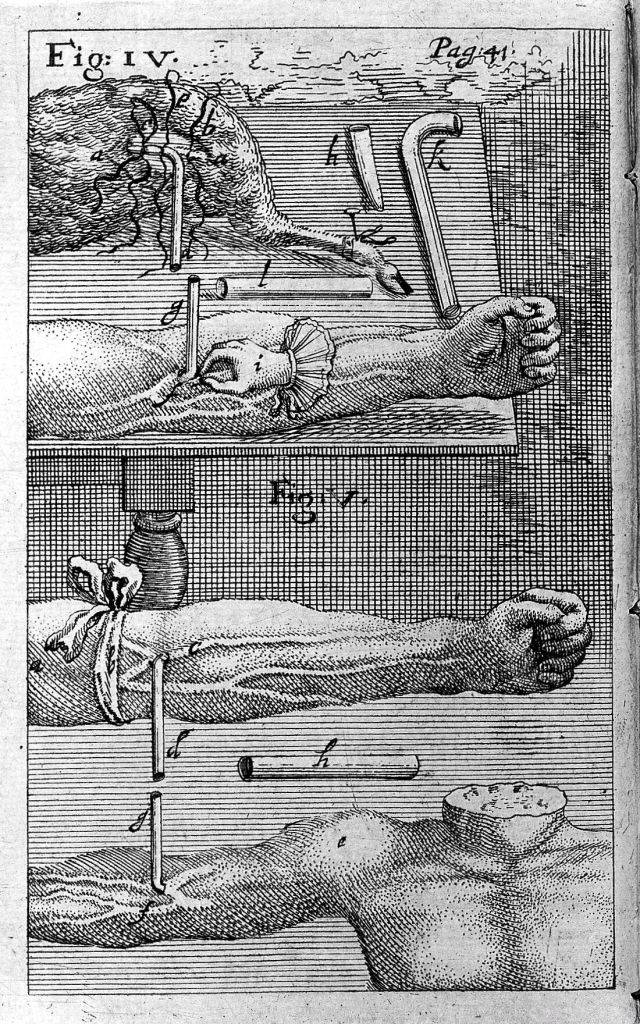
(Photo: Wellcome Collection)
I said that this is all about Coga the Sheep. Thus far I have mentioned both a sheep and a human and you might have assumed that the sheep was called Coga. Now, it was not my intention to pull the wool over your eyes, but Coga was not, in fact, the sheep in this scenario, but the man. Dun dun DUN!!! I know! The person who received the sheep’s blood was a man called Arthur Coga.

Tracta Code item De Motu & Colore Sanguinis, 1669 (Photo: University of Iowa)
Basically, for the choice of human in the experiment, the Royal Society wanted someone educated (who could report reliably on the results) and someone who was unwell in some way (so they could justify the experiment by claiming that it might make him better). They chose Arthur Coga. A Cambridge-educated gentleman who knew Latin and had spent some time as a clergyman. He also struggled with his mental health. It’s not entirely clear what he suffered from in modern terms, but it was said that his “brain is sometimes a little too warm” and that he was “look’t upon as a very freakish and extravagant man”. The Royal Society were hoping that the transfusion might help cool his blood.
It didn’t, because that’s not how science works.
Amazingly, he survived the transfusion and only suffered from a few brief fevers (sadly, I wasn’t able to find out what happened to the sheep). He underwent a second transfusion and it was claimed that fourteen ounces of blood was transferred from yet another sheep to Coga. Many in the crowd heckled that they did not believe all that blood had been pumped into Coga and I don’t blame them for being sceptical! It’s more than likely that little or no blood was transferred between the two. There was about 45cm of pipe separating sheep and man. Sufficient enough distance for the blood to cool and congeal and stick to the sides of the pipe, thus obstructing the flow of blood. Testament to that is the fact that Coga survived yet again with just small fevers as a result. The Royal Society even had the cheek to blame the fevers on Coga himself for drinking too much wine.
Coga never really overcame his mental health struggles. He even claimed that his two transfusions had actually “transformed him into another species” (although, considering Boyle’s questions about what might happen to dogs after a blood transfusion, Coga’s response to his own transfusion isn’t that far from genuine scholarly thought at the time). He refused a third transfusion, claiming that the backlash from the first two had caused “the loss of his own wool” – essentially that he’d been left penniless and had been reduced to pawning his own clothes. To be fair to Coga, he’d only been paid 20 shillings each time he’d been topped up with another animal’s blood. He wrote a letter to the Royal Society, asserting that he would undergo no further procedures until the Society completed their work and actually transformed him entirely into a sheep.
He signed the letter, “the meanest of your flock, Agnus Coga”. Aka Coga the Sheep.
Overall, despite this being a really important moment in medical history, it was generally met with public mockery, partly because of Coga’s choice as a subject, and transfusion research ground to a halt. It’s not until 1818 that we get the first recorded successful human-to-human blood transfusion. Over 150 years later.
The Cotswold Lion
Rawr! Bet you weren’t expecting a lion when you started reading this blog post!
Okay, admittedly, this is the “lion” in question.

Not exactly a terrifying beast, but this breed is genuinely called the Cotswold Lion. It’s a dual-purpose breed, so used for both its meat and its wool, and it’s featured in this blog post because it was once vitally important to the English economy.
Particularly between the late thirteenth and late fifteenth centuries, wool was the backbone of our economy and Cotswold wool specifically was admired across Europe for its golden lustre and high quality. Merchants would travel from places like Flanders and Lombardy, centres of weaving and cloth-making, to buy this wool.
It was even nicknamed the “Golden Fleece Breed”. Okay, maybe I wouldn’t necessarily compare little ol’ Baa-tholomew to the golden-wooled, winged ram of ancient Greek legend, but you get the idea – we’re talking about a pretty highly-prized animal in Medieval English society.
When Richard the Lionheart was captured by the Duke of Austria in 1191, part of his huge ransom was paid with 50,000 sacks of English wool (so I like to imagine that it was the Cotswold Lion rather than an actual lion which gave the King his nickname). In the fourteenth-century, Edward III went to war with France, partly to protect the English wool trade with Flanders (that went on to become the Hundred Years War, so not exactly a quick skirmish). By 1520, wool and cloth (from eight million sheep!) made up about 80% of England’s exports. “Wool churches” are genuinely a thing in the Cotswolds – vast churches (almost out of proportion with the size of the towns and villages where they were built), which were constructed mostly in the late fifteenth and early sixteenth centuries, funded by merchants who had made their money in the wool trade. The most famous of these wool churches is in Cirencester, nicknamed the “Cathedral of the Cotswolds”. In 1612, Bishop Hall of Norwich said that there were “three wonders of England: ecclesia, foemina, lana” – “churches, women, and wool”. The Lord Speaker in the House of Lords continues to sit on a woolsack to this day in honour of sheep and their historic significance to England (although, hilariously, it had to be re-stuffed in 1938 because it was discovered that the famous “woolsack” was actually full of horsehair – oops). And my favourite nod to our woolly saviours: Tetbury in Gloucestershire still host annual Woolsack Races. Not just any Woolsack Races, but the World Championship of Woolsack Races. It’s believed these races started in the seventeenth-century. Contestants have to run the 300m up Gumstool Hill with a woolsack on their backs. In classic English fashion, the race takes place between two pubs.

And while the Cotswold Lion is now listed as “at risk” by the Rare Breeds Survival Trust, there are still about 85 small flocks across the Cotswolds and the breed has diversified to stay relevant. They’ve found a new industry: Father Christmas beards. Yes. Apparently the Cotswold Lion has a new market in the production of facial hair for jolly old Saint Nick. So, not only did the Cotswold Lion once protect the English economy, it has also now saved Christmas. What a frickin’ legend.

Beatrix Potter’s Sheep
So these sheep are more “famous by association”. In particular, their association with beloved children’s author, Beatrix Potter.
Beatrix Potter, author of Peter Rabbit, was also responsible for almost singlehandedly conserving the ancient breed of Herdwick sheep.
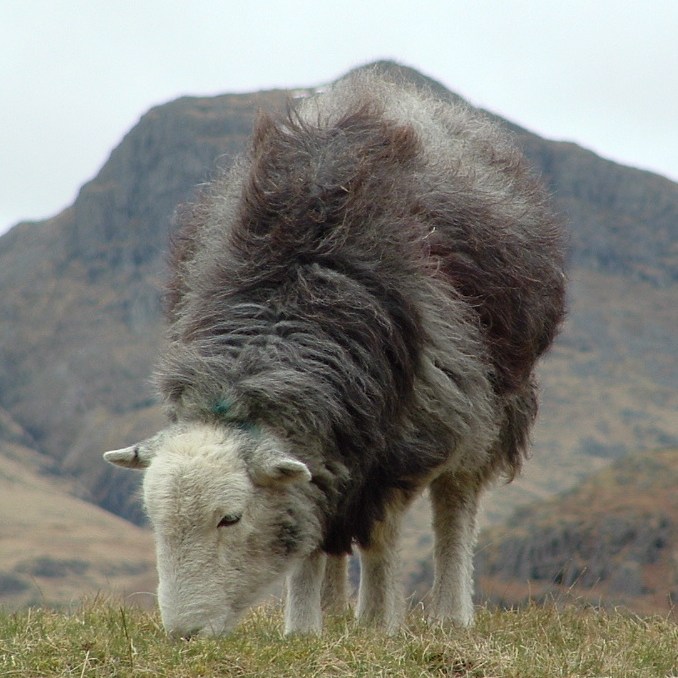

(Photos: Wikimedia Commons)
Herdwick sheep are quite special to this country (and we’ve already talked about how much we love sheep). It’s a 10,000 year old breed, first brought to England by the Vikings in about 800 AD (“Herd-vyck” is Old Norse for “sheep farm or pasture”) and about 90% of the world’s population live in England. More specifically, Cumbria.
And they’re tough.
They live up North, so they have to be.
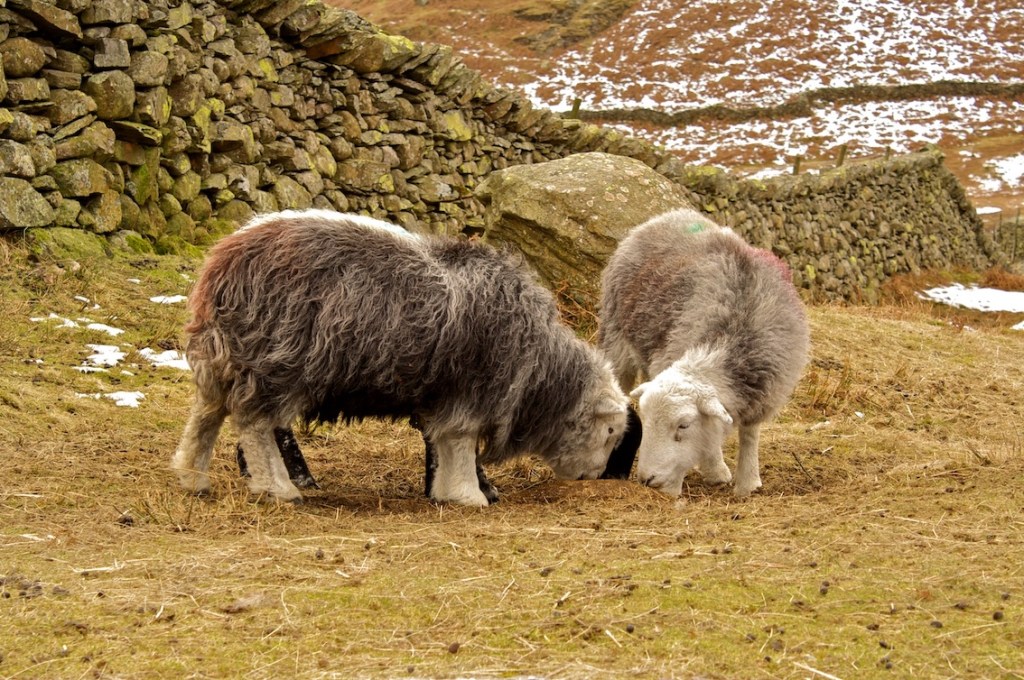
They are well adapted to the harsh conditions of the Lake District. Wooly faces and small ears to withstand the cold, a double coat of wool to keep them waterproof (seeing as they live in an area with the highest rainfall in the country), and stocky, strong legs to deal with the rough terrain. In the 1960s, a Herdwick flock survived alone for three months in the winter, stranded in snow on a mountainside and surviving on scraps of moss and lichen.
Their rough, hardy fleece means that they’re generally preferred for their meat – a distinct, gamier flavour which comes from grazing on the heather, bilberry, and grasses of the Lake District fells. In fact, Herdwick lamb was served at Elizabeth II’s Coronation Dinner in 1953 (and if it was good enough for the Queen, it’s good enough for the rest of us riffraff).
We have, however, found uses for the fleece so it doesn’t have to go to waste: rugs and carpets, blankets, army clothing, loft insulation, and mixing it with bracken to make compost.
So it’s not just that Herdwick sheep are riding on the coattails of Beatrix Potter. They’re also important to our history. They’ve become synonymous with the Lake District, the farming of these sheep has shaped the local landscape of Cumbria, and they’re part of why the Lake District gained its UNESO World Heritage status. Thanks sheep.
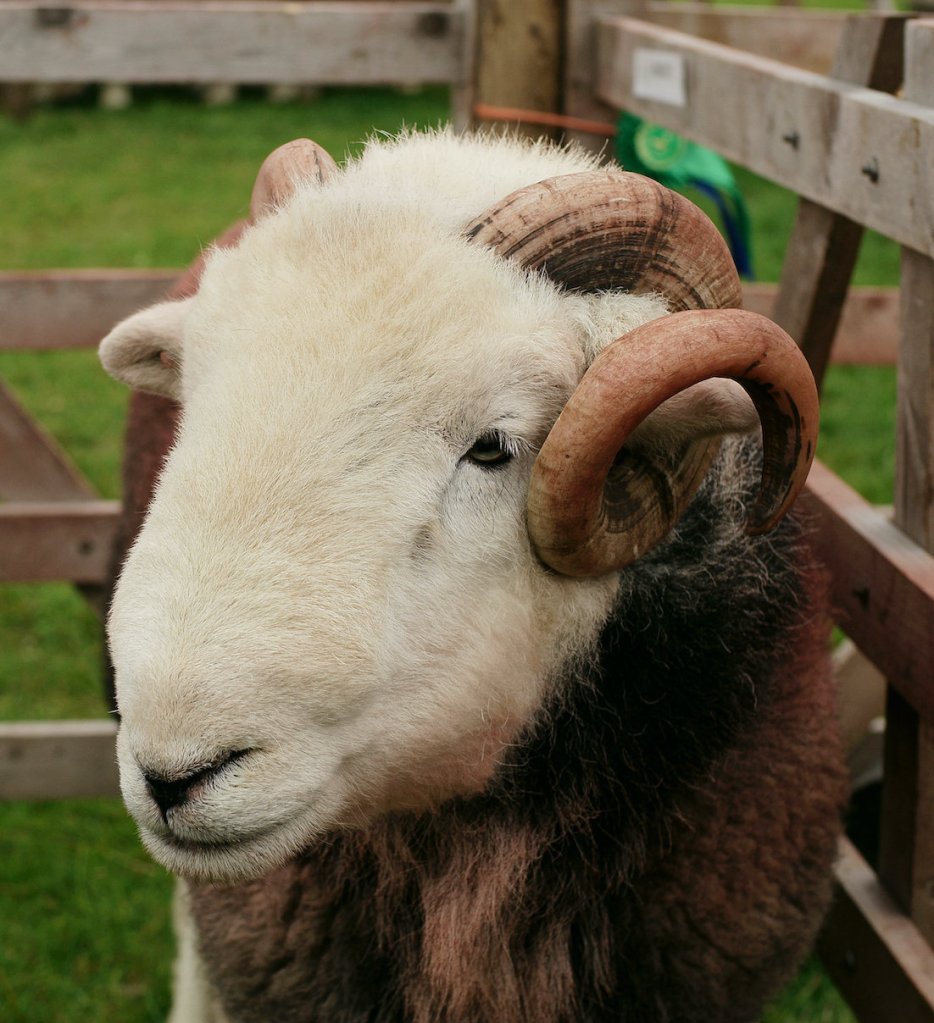
We’re just lucky that Beatrix Potter realised their importance too, because the breed was struggling by the time she took them under her wing. She’d first encountered Herdwick sheep as a child, on family holidays, and fallen in love with their friendly, smiley faces.
They’re almost teddy bear-like with their wooly snouts. Look at the little face!
By the time she returned as an adult, the population had dwindled to just a few hundred.
Cue Beatrix Potter, first of her name, Protector of the Lake District, Mother of Sheep.
She became a pioneer in farming conservation and an expert Herdwick breeder, invested the money from her books into buying up farms, and was the first female president-elect of the Herdwick Sheepbreeders’ Association. By the time she died, the population of Herdwick sheep had gone from hundreds to thousands and she left fifteen farms to the National Trust, covering almost 4,000 acres. One of her stipulations was that the sheep on these farms would be kept as pure Herdwicks.

(Photo: National Trust)
Today, there are about 50,000 Herdwick sheep kept commercially on around 120 farms. These sheep are now being so well looked after that as of 2013, they were awarded protected status (on par with champagne, darling) and in 2016, agricultural students from a college in Cumbria took a number of Herdwick embryos, fertilised eggs and some semen and had them stored in a gene bank so the breed could be protected for future generations. That’s a pretty successful legacy.
Honourable Mention: Montauciel
Even though he’s right at the end and technically outside the remit of British history, Montauciel is my personal favourite and actually inspired this entire blog post, so I felt he deserved a mention.
A long time ago now, I was wandering through the Science Museum in London when I stumbled across the fascinating tidbit that a sheep had taken part in the first human-designed flight involving a living creature. Whaaaat??
The year was 1783. The location: Versailles, France. The Montgolfier brothers had been experimenting with flight and on 19th September, they demonstrated the first ever hot air balloon flight with living passengers.
Thousands gathered to see these brave souls. Even the King and Queen, Louis XVI and Marie Antoinette, were there to witness the spectacle. How would altitude affect living beings? Would they survive the flight? Would the whole endeavour crash and burn?
As you can imagine, from the general theme of this blog post and the human capacity for self-preservation, the passengers chosen for this maiden voyage were not human.
They were a duck, a rooster, and, of course, a sheep. His name was Montauciel – French for “Climb to the Sky”. A fitting name for a history-making sheep. Sadly, no one seemed to care about the duck or the rooster or maybe Montauciel stole the limelight (classic sheep) because they don’t seem to have names.
There was some logic to the choice. Montauciel was chosen because a sheep was considered the most similar to humans. The duck, because it was an animal which already experienced (and survived) high altitudes. And the rooster was a control for the duck. It was a bird, but it couldn’t fly, so the reasoning was that its results could be compared to the duck. It all sounds very reasonable.
Interestingly, as a little side note, the most common fuel for these early hot air balloons was to burn a combination of straw and wool – yet another thank you to our ovine friends.
You can picture the scene. A huge blue and gold balloon, decorated with gold fleurs-de-lis.
As it inflated and lifted from the ground, this unexpected group of pioneers experienced a glorious eight minutes of flight before landing in a wooded area about two miles away. The animals appeared relatively unharmed from their historic endeavour. The only injuries suffered were from Montauciel kicking the rooster (not particularly great airline etiquette…), but they all survived.

(Photo: Wikimedia Commons)
By the following month, humanity had been so inspired by the bravery and success of Montauciel and his feathered companions that we had the first balloon flight with a human on board. That honour went to Jean-Francois Pilatre de Rozier, but he’s not a sheep so we don’t really care.
Back to Montauciel.
Apparently, he was later adopted by none other than Queen Marie Antoinette, although I haven’t been able to find any convincing sources for that little tidbit, so I don’t know if it’s true. However, I like to imagine our wooly aeronaut living out the rest of his days in pampered luxury, possibly in his own wing of Versailles. As for the duck and the rooster, unfortunately I wasn’t able to find any reference to them. Although we know how fond the French are of duck a l’orange and coq au vin…
What a lovely note to end on.
So all in all, you committed to reading two blog posts about sheep and you’ve ended up with a lion, a human, and a clone. Who knew sheep could be so versatile??
And if you missed Part 1 and you’re now desperate to read it, look no further:

Rambling London Tours – Home – Tours – Newsletter.
Sources
Coga
- ‘First Blood Transfusion’, JSTOR Daily, (accessed 10/09/2024)
- ‘The (Mis)Fortune of “Coga the Sheep”‘, Yale University Press, (accessed 10/09/2024)
- ‘When people thought blood transfusions would give them animal powers’, The Vintage News, (accessed 10/09/2024)
- H. Tucker, Blood Work, (2011)
The Costwold Lion
- ‘History of the Wool Trade’, Historic UK, (accessed 10/09/2024)
- ‘Richard Lionheart’, Historic UK, (accessed 10/09/2024)
- ‘Churches and Wool’, History Today, (accessed 10/09/2024)
- ‘Woolsack’, UK Parliament, (accessed 10/09/2024)
- ‘Cotswold Sheep’, Wikipedia, (accessed 10/09/2024)
- ‘The Tale of the Cotswold Lion’, John Eckersley, (accessed 10/09/2024)
- ‘How the sheep of the Cotswolds outlasted the Roman Empire and the Black Death to help build one of Britain’s most beautiful areas’, Country Life, (accessed 10/09/2024)
- A.R. Bell, C. Brooks, P.R. Dryburgh, The English Wool Market, c.1230–1327, (2007)
Beatrix Potter’s Sheep
- ‘Herdwick Sheep’, Herdwick Sheep Breeders Association, (accessed 10/09/2024)
- ‘Famous Writers’, Lake District National Park, (accessed 10/09/2024)
- ‘Farming’, Lake District National Park, (accessed 10/09/2024)
- ‘The Smiley-Faced Sheep of Beatrix Potter’, Conference of Northern California Handweavers, (accessed 10/09/2024)
- ‘Protected Food Name: Lakeland Herdwick PDO’, gov.uk, (accessed 10/09/2024)
- ‘The English Lake District’, UNESCO, (accessed 10/09/2024)
- ‘Herdwicks: The ‘smiley’ sheep that shaped the Lake District’, BBC News, (accessed 10/09/2024)
- ‘Gene bank project to protect Herdwick sheep breed’, BBC News, (accessed 10/09/2024)
- ‘Learn All About Herdwick Sheep’, Herdy, (accessed 10/09/2024)
Montauciel
- ‘A Rooster, a Duck, and a Sheep Walk Into a Hot Air Balloon…’, Atlas Obscura, (accessed 10/09/2024)
- ‘First Balloon Flight’, Guinness World Records, (accessed 10/09/2024)
- ‘Balloon’, Britannica, (accessed 10/09/2024)
- ‘3 Individual Animals Who Changed The Course of Human History’ Medium, (accessed 10/09/2024)
- ‘Men fly over Paris in hot air balloon’, History, (accessed 10/09/2024)
- ‘Pilâtre de Rozier And The World’s First Aviation Accident’, Amusing Planet, (accessed 10/09/2024)
- ‘Jean-François Pilâtre de Rozier’, Wikipedia, (accessed 10/09/2024)
 Rambling London Tours