

If you’d visited London in the late eighteenth-century, it’s possible you’d have come across a man called John Bobey.
Sadly, you’d have seen him as part of an exhibition of wild animals.
John Bobey was born in the Caribbean in the 1770s. Unfortunately, a lot of our information about him is speculation or comes from second-hand accounts, many of which were less interested in accuracy and more concerned with promoting John’s “exotic” nature or “Otherness”.
Some say he was born in Jamaica, others St. Lucia. Some say 1772, others 1774. His parents were both enslaved, the slave owner was a Rev. Mr. Pilkington and they lived near Kingston, Jamaica.
Bobey was deemed a curiosity because he had a condition which caused the patchy pigmentation of his skin. As a result of his appearance, from the age of just two years old, he was being exhibited in Jamaica. And sadly, he wasn’t alone. There are several other examples of people, of children, who looked similar to Bobey being put on display, paraded like animals for the entertainment of white audiences.
The modern assumption is that he had vitiligo (an autoimmune condition which results in patches of depigmented skin over time), but some modern scholars believe it was more likely piebaldism (absence of melanin-forming cells from birth).

(Photo: The Library Company of Philadelphia)
By 1789, he was in London. Most of our information concerning Bobey comes from the only contemporary biography of him – entitled The New Wonderful Museum and Extraordinary Magazine by W. Granger – although we still have to take it with a pinch of salt, because it wasn’t written by Bobey and it is, itself, a problematic text. It is all about entertainment and spectacle – advertising the “wonders, curiosities, and rarities of nature and art”. Generally, however, the account is quite favourable towards Bobey. Hopefully, there is some truth to the source because we have at least one fact that can be found in the historic record. Granger says that Bobey was baptised John Richardson in 1789 at St. John’s in Liverpool and we do actually have his baptismal record.

He is John Bobey, John Richardson, Primrose, John Richardson Primrose Bobey, “the Wonderful Spotted Indian”, “the Celebrated Piebald Boy”. R.A. Hogarth in his article theorises that “Primrose” may have been the alias that Bobey used early in his career as a sideshow act, but it’s unclear when exactly he adopted the name or if it was forced upon him. Later in his career, however, he chose to go by the name John Bobey.
Bobey was originally exhibited on Haymarket in London for two months before he was bought by showman Thomas Clark and moved about ten minutes down the road to Strand. Clark had a shop in the Exeter Change, a building on the north side of the street (just east of Burleigh Street today), which was demolished in 1829. From the 1780s, Clark had leased the second floor and started exhibiting wild animals, like lions, and, sadly, people like Bobey.


(Photo: Horwood Map, Layers of London)
Common throughout Bobey’s story, are people like the Liverpudlian merchant who declared him to be “the greatest Curiosity in nature he ever saw”, the decision to send Bobey to Oxford University for “inspection”, his visit to Buckingham Palace (then House) for similar scrutiny by the King and Queen, and the ignorance of some who “examined and rubbed” his skin believing Bobey to be painted. One of the most unpleasant accounts is the visit by Prince William of Gloucester, George III’s nephew, who “would frequently pretend to beat Bobey, while the consequent rage of the savage [“an Arabian savage” housed near Bobey] afforded much mirth to the company”. This “Arabian savage”, as he’s described (where he was from specifically we will possibly never know), was another person who was on display like Bobey for the amusement of white visitors. He apparently became quite close to Bobey, so while he’s portrayed in this animalistic rage, you can imagine that he was likely just furious on behalf of his companion. One friend trying to defend another.
Bobey was also exhibited in other parts of the country. This is an advert from one such occasion when Bobey was put on display in Hull with three other people, possibly with dwarfism… and an armadillo. Entry was a shilling.
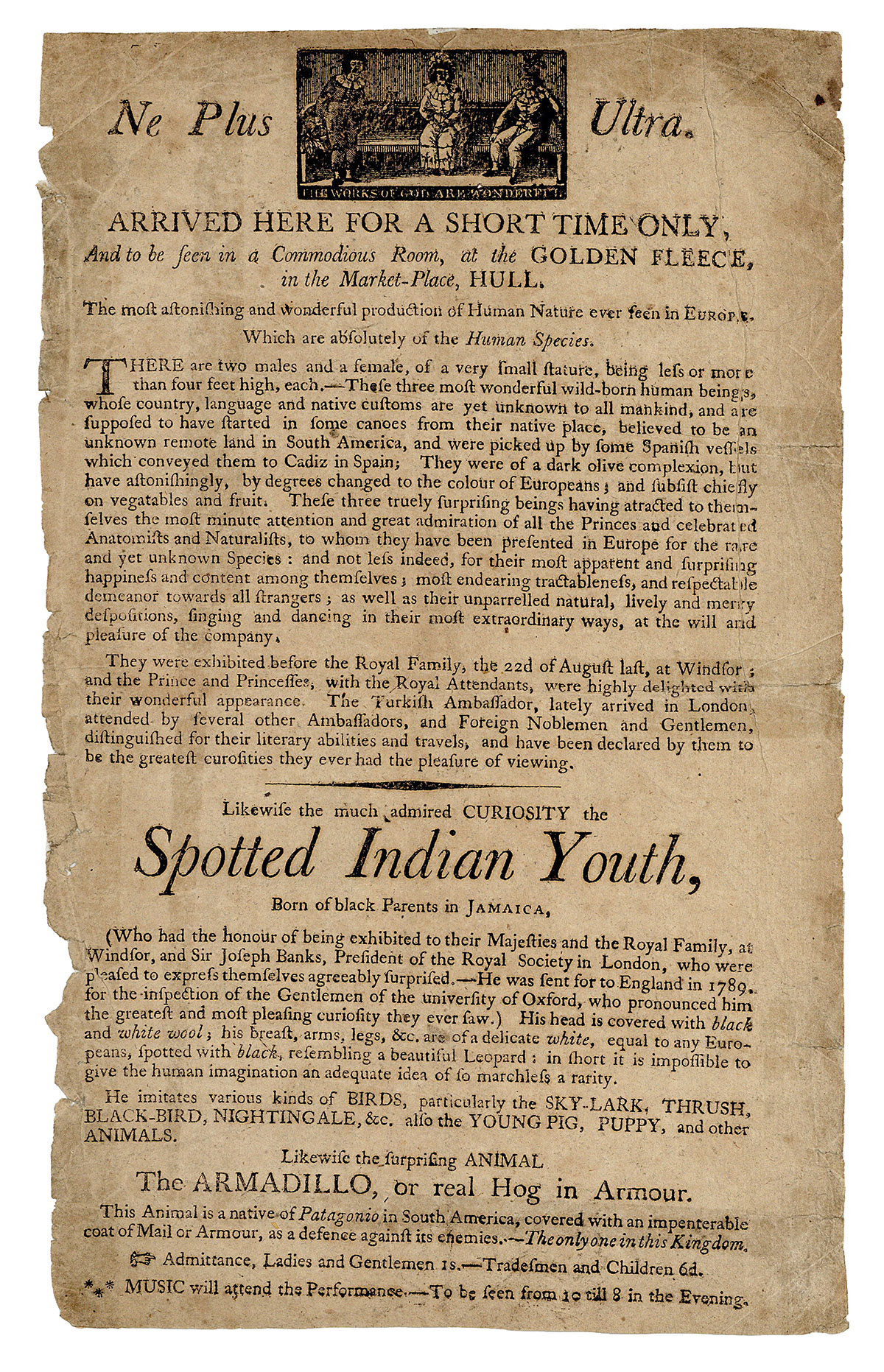
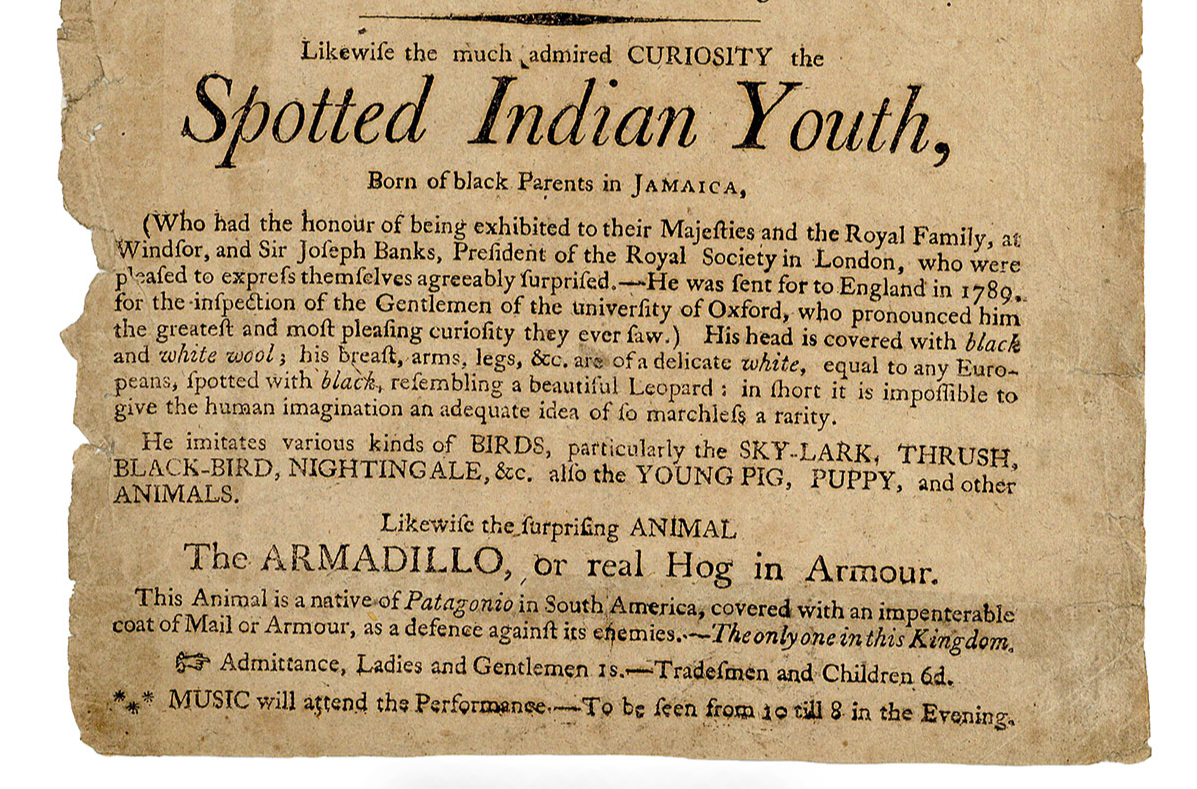
Advert from Hull, 1790 (Photo: Potter Auctions)
In 1795, six years after Bobey’s arrival in London, a German physician and naturalist, Johann Friedrich Blumenbach published a description of Bobey, having visited him in London. “I saw an Ethiopian of this kind at London, by name John Richardson, a servant of T. Clarke, who exhibited there (in Exeter Change), live exotic animals as shows and also for sale. The young man was perfectly black except in the umbilical and epigastric region of the abdomen, and in the middle part of either leg, that is the knees, with the adjoining regions of the thigh and the tibia, which were remarkable for a most brilliant and snowy whiteness, and were themselves again distinguished by black scattered spots, like those of a panther.” Blumenbach conducted research into the “origins” of Black skin and decided the world was carved up into five races, with white people being the original. Of course. Blumenbach was opposed to the slave trade, but that didn’t stop him from evaluating Bobey as a specimen and comparing him to an animal. He noted that his hair was “also parti-coloured” and even asked Bobey to give him “a specimen of each kind of hair”, which implies quite a close, almost clinical, examination, rather than just a distant observation.

(Photo: The Repository of Arts Vol.8)
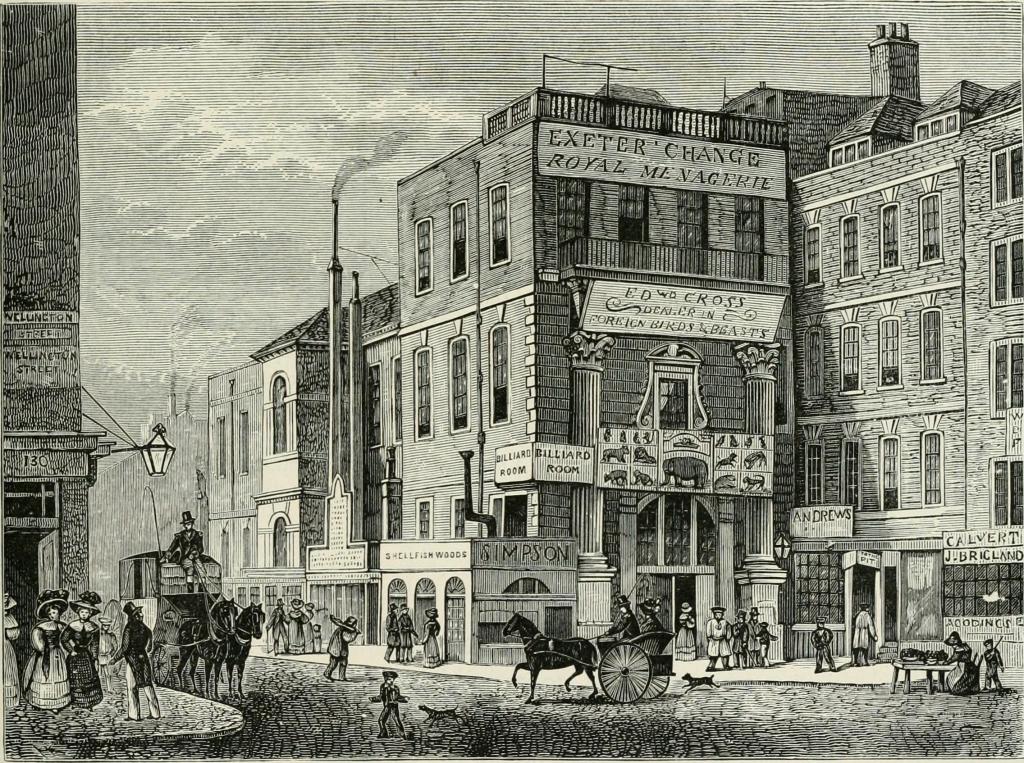
(Photo: Wikimedia Commons)
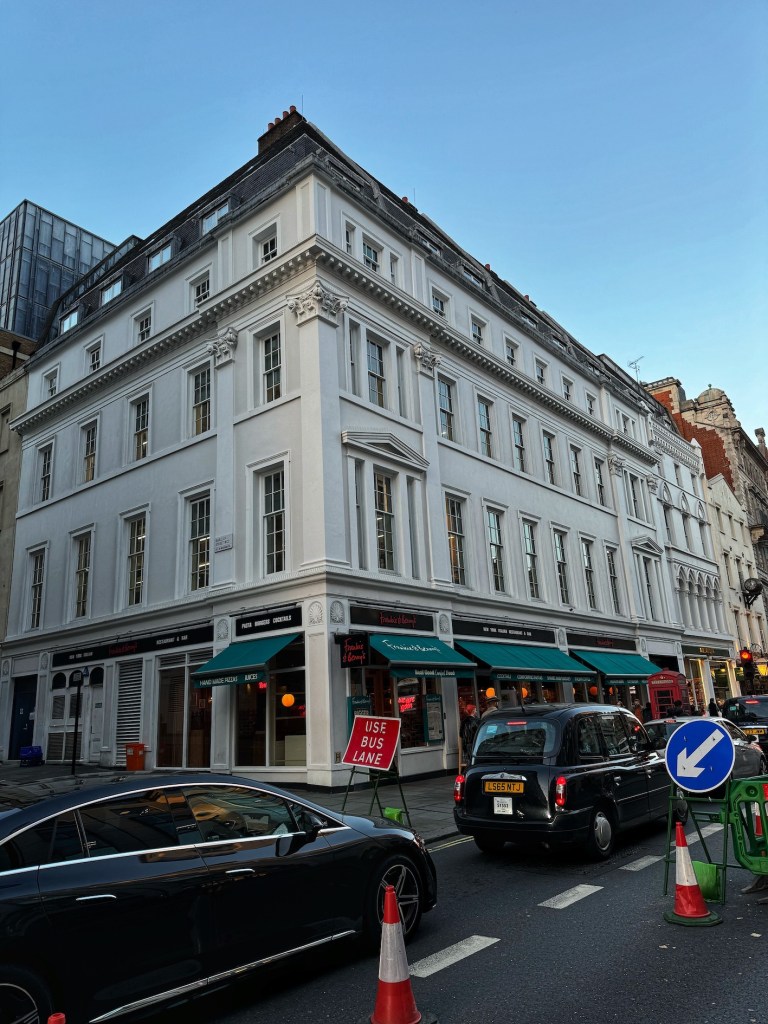
I wish I could share Bobey’s voice, rather than these descriptions from “men of science” who considered him a specimen, or the adverts declaring him a spectacle, or the accounts of white visitors who saw him as a prop or exciting anecdote. He was not a specimen or a spectacle or a story, he was a human being.
The closest we get to his voice are the pieces we can read between the lines and snippets from The New Wonderful Museum.
He is described as “affable” and “so very correct”. He imitates songbirds. He comes across as level-headed, business-minded, and intelligent. There are a couple of references to how he educates himself about England, its constitution, and his rights as a person in this country. And it’s this awareness and determination which eventually leads to his freedom.
Often, however, rather than getting Bobey’s actual words, the author puts his words in Bobey’s mouth and the end of the biography features a poem, written as if from Bobey’s perspective:
“In short, this pure child of nature seems to say
Though partly black and partly white my hue,
No double-dealer I, like some of you:
Think not the colour black is a disgrace,
And that on Cain’s account God mark’d our race
Did Providence thus smite us for our sins,
How many white men would have blacker skins.
Then it is plain some Christians judge not right,
For look at me – I am both black and white!
By one Creator all of us are made,
And thus behold his wond’rous pow’r’s display’d.”
It is, all things considered, quite sympathetic towards Bobey. Very simply, the poem says being Black is not a bad thing, it’s not a “disgrace” and it challenges one of the preconceptions at the time that the “curse of Cain” – Cain’s punishment for murdering his brother in the Bible – was to be marked with Black skin. A sign of sin. The poem basically argues that if that were the case, there would be plenty of white people with darker skin than Bobey. It ends by saying, despite our differences, God made us all and it’s that variety in humanity which is evidence of his “wond’rous pow’r”.
To end with Bobey himself though. While we don’t have his words, we have an account of his actions.
By the early nineteenth-century, he had gained his freedom, married an Englishwoman and they had started their own menagerie. It’s not clear how much he was still an “exhibit” in his own business – we have at least one instance in 1795 where he exhibited himself at the Bartholomew Fair in Smithfield – or how he felt about being a part of the industry which had dehumanised him for the majority of his life.
Maybe he was still confined by the trappings and expectations of nineteenth-century society, maybe he felt like he was claiming ownership over what had once imprisoned him. We will probably never know.
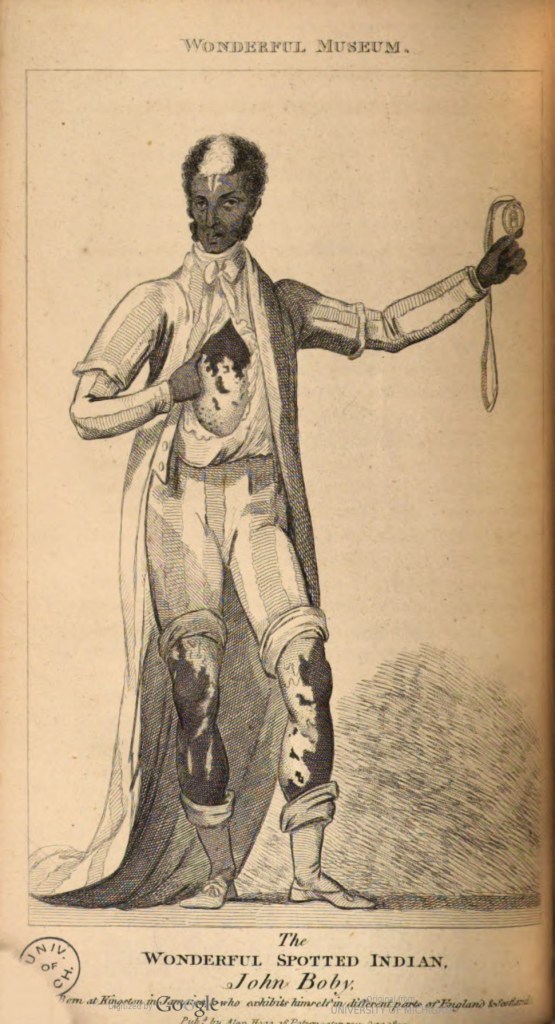
(Photo: HathiTrust)
Bobey also became a member of the Free Masons, one of the most exclusive societies in the world. He was a member of the masonic lodges of The Union and Crown Lodge (Glasgow) and Minerva Lodge (Hull) – in the latter, he reached the position of Royal Arch Freemason. In his engraving from 1803, he is holding a Royal Arch jewel (arguably the most important of all Masonic Jewels).
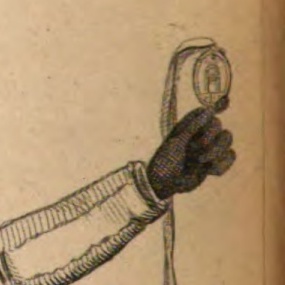
(Photo: HathiTrust)
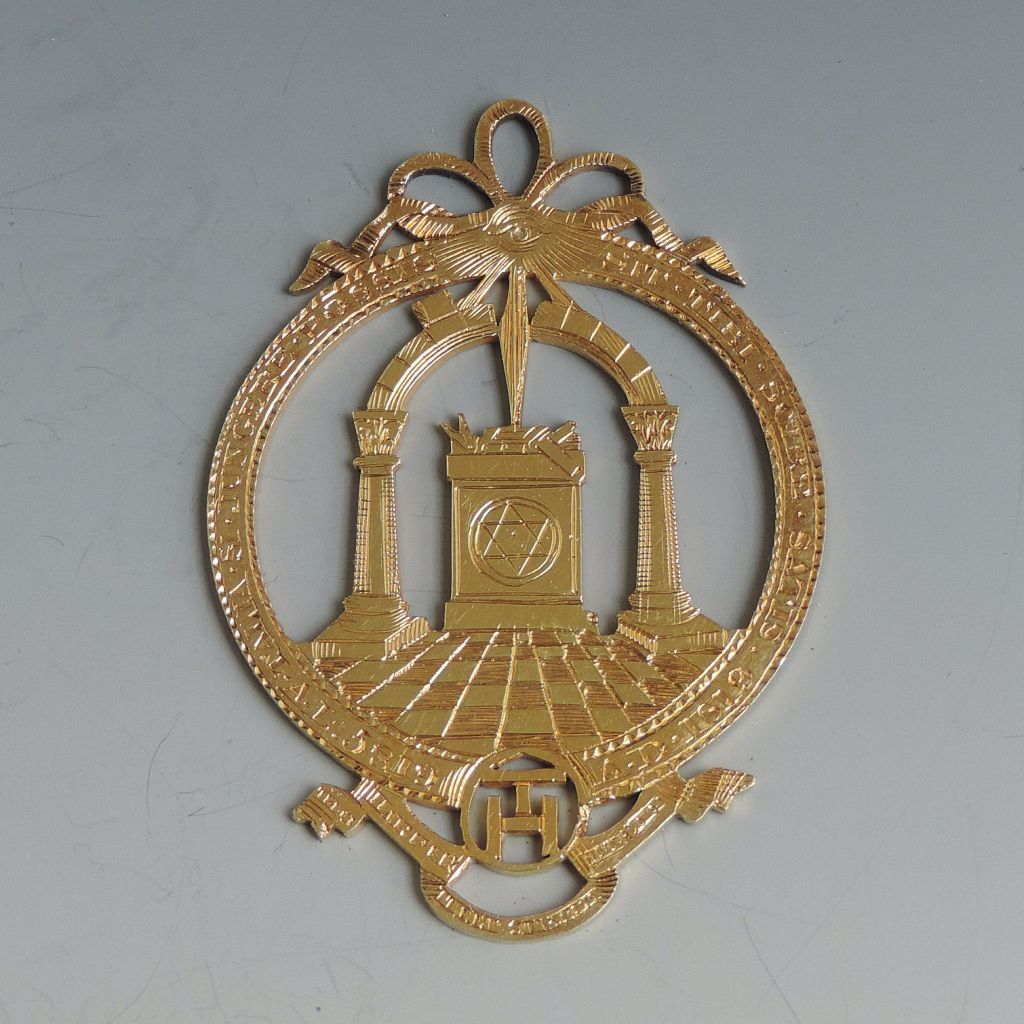
(Photo: Steppes Hill Farm Antiques Ltd.)
In addition, that image from 1803 shows him in a more European style of clothing. A far cry from his depiction in 1789, dressed in nothing but a loin cloth with generic wilderness sketched in behind him. Again, we don’t know what Bobey thought of this transformation or if he had a say in how he was portrayed in the latter image, although according the New Wonderful Museum, the image was “taken with his own Approbation, having favoured us with his Company several times, and sat to our Artist”. From a European perspective, however (because both of these images were created by and primarily for white audiences), Bobey had risen from the “wild savage” to a “civilised” English gentleman. Whether he would have been treated as such in everyday society is another matter. And, in both, despite a change of outfit, he continues to be treated as a curiosity. In the latter image, Bobey still draws back his shirt to display the varying pigmentation of his skin. Despite everything, he is expected to be on display.
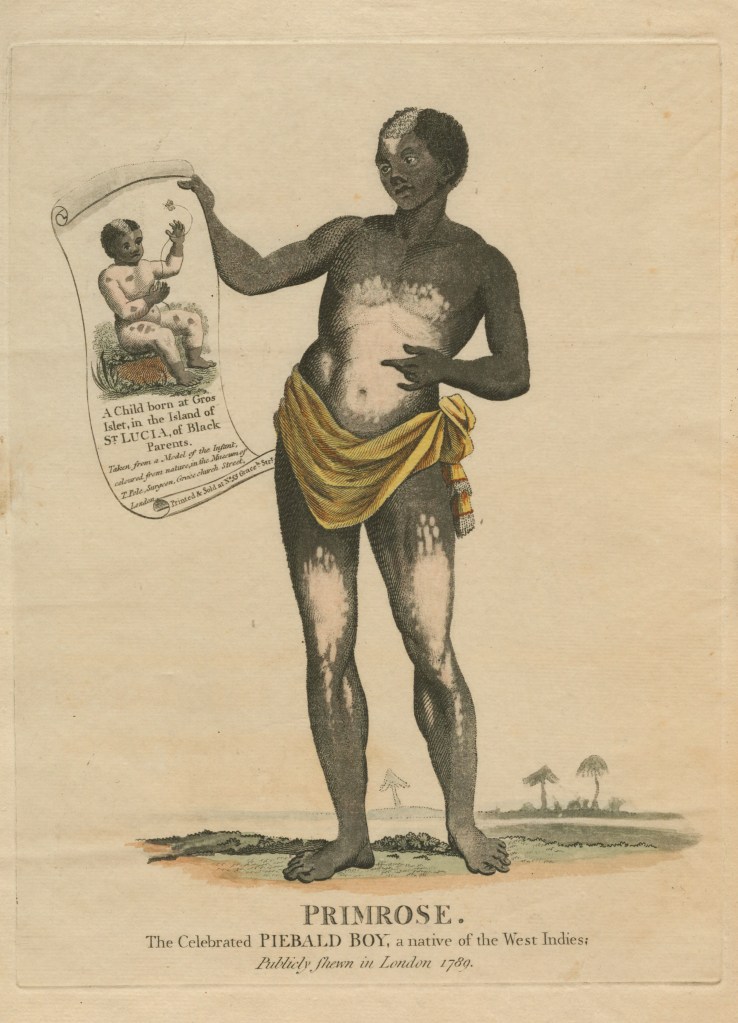
The one quote we have from him shows his strength of character. Again, we have to hope they’re his words, but it’s the closest thing we have. In 1793, Thomas Clark sold his menagerie at the Exeter Change. He sold the animals off one by one, but when the auction reached Bobey, he refused to step forward.
“I can‘t stand that, I will not be sold like the monkeys.”
Despite Bobey’s protestations, a man called Gilbert Pidcock was still able to purchase the remainder of Bobey’s apprenticeship for 50 guineas. He is, however, paid a salary and it is some time after that that Bobey is finally able to achieve his freedom.
I wasn’t able to find out what happened to Bobey in later life, when he died or where he was buried, but I do hope that he was able to carve out some slice of happiness in a society that was stacked against him. Thankfully, we do know that he managed to get his freedom, he found a wife, and he was a budding entrepreneur.
Regarding his menagerie, there is a brief description of it in the The Eccentric Mirror by George Wilson, another a brief biography of Bobey’s life (although it largely seems to be a copy of The New Wonderful Museum):
“By a proper application of their savings, they soon made up a good collection of monkeys, birds, beasts, etc and notwithstanding the expense of travelling, and the keep of five horses and men, which is at least two guineas a day, yet such are the exertions and industry of this couple, and the satisfaction they give at all the principal fairs, that
there is little doubt but in a short time they will accumulate a decent fortune.”
Maybe one day we will be able to finish John Bobey’s story.
Rambling London Tours – Home – Tours – Newsletter.
Sources
Primary
- W. Granger, The New Wonderful Museum, Vol.II, (1804)
- W. Wilson, The Eccentric Mirror: Reflecting a Faithful and Interesting Delineation of Male and Female Characters Ancient and Modern, Vol.II, (1807)
- ‘On the Natural Variety of Mankind’, J.F. Blumenbach, (3rd edition, 1795), in The Anthropological Treatises of Blumenbach and Hunter, (1865)
Secondary
- ‘Thomas Clark, Eccentric Entrepreneur and multimillionaire’, All Things Georgian, (accessed 20/10/2024)
- ‘Associates’, Equiano’s World, (accessed 20/10/2024)
- ‘Exeter Exchange’, Wikipedia, (accessed 20/10/2024)
- ‘To “excite the curiosity, and gratify the beholder”‘, R.A. Hogarth in Journal for Early Modern Cultural Studies, 18.1, University of Pennsylvania Press, (2018)
- ‘The Role of Men of Colour in the Early Period of Freemasonry’, E. Oscar Alleyne in Freemasons in the Transatlantic World, (September 2018)
- ‘Exotic Animals in Eighteenth-Century Britain’, C. Plumb, (2010)
 Rambling London Tours